
Enter Your Email to Be Notified When Discounted Tickets Become Available
Enter Your Email to Be Notified When Discounted Tickets Become Available
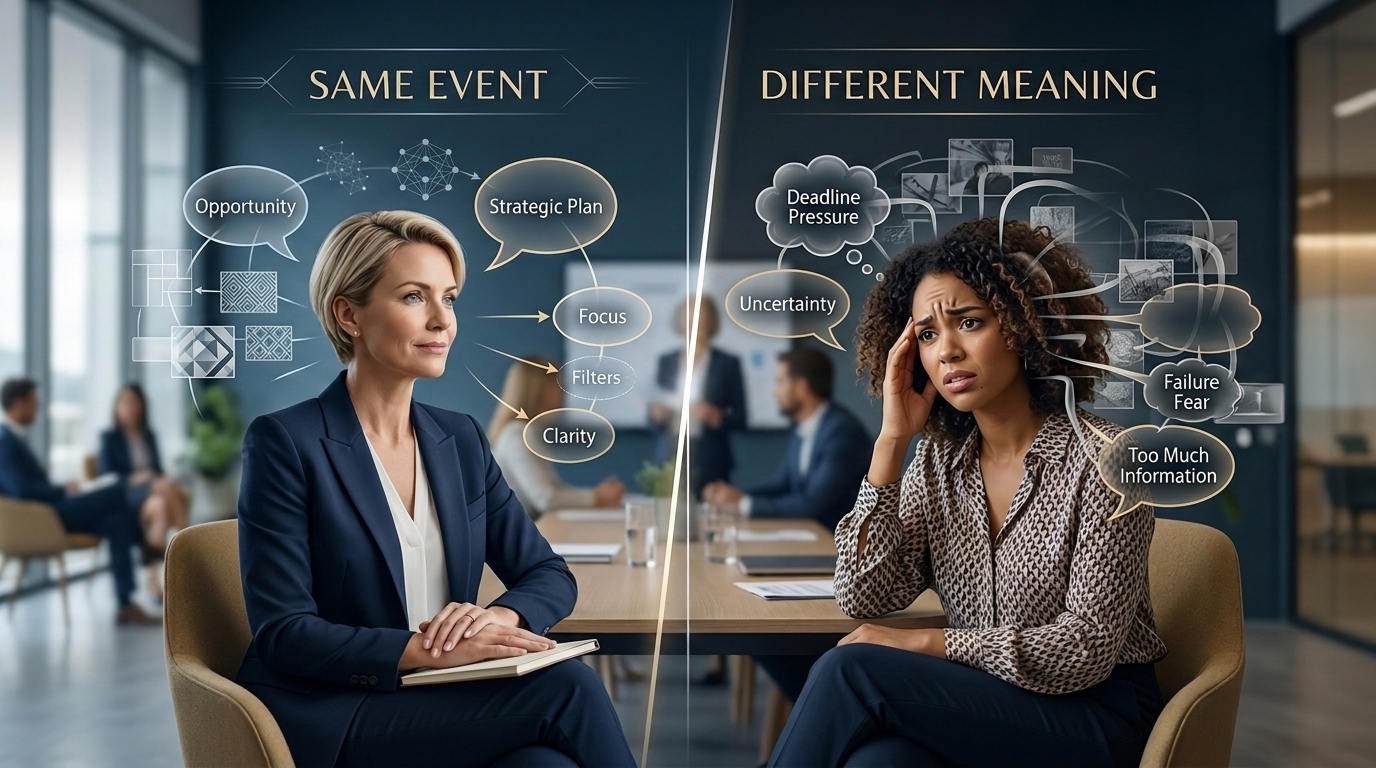
Two people walk into the same meeting.
The manager looks at both of them and says:
“I need to talk to you later.”
One person nods, finishes their work, and barely thinks about it again.
The other feels their stomach tighten.
Their mind starts racing.
Did I make a mistake?
Am I in trouble?
Did someone complain about me?
For the next three hours, they replay every conversation, every email, every decision they made that week.
Same manager.
Same words.
Same event.
Completely different emotional experience. Why?
Because we do not simply respond to what happens.
We respond to what our mind believes it means.
And understanding that one idea can completely change the way you see yourself, your relationships, and the way your mind works.
Think about public speaking.
One person hears: “You need to give a presentation next week.”
Their first thought is:
This is my chance to share what I know.
They feel excited.
Another person hears the exact same sentence and thinks:
Everyone is going to notice how nervous I am.
They feel panic.
Or imagine sending someone a message and not receiving a reply.
One person thinks: They are probably busy.
They put their phone down and continue with their day.
Another thinks: I said something wrong.
They reread the conversation ten times.
The external situation is the same.
The internal experience is completely different.
This happens everywhere.
One person loses a job and sees failure.
Another sees an opportunity to begin again.
One person receives criticism and feels attacked.
Another hears feedback and looks for what they can learn.
One person faces uncertainty and feels fear.
Another feels possibility.
So what creates the difference?
Meaning.
We often speak as if events create emotions directly.
We say:
“That person made me angry.”
“That situation made me anxious.”
“That failure destroyed my confidence.”
And certainly, events can affect us deeply.
But there is often an important step happening between the event and the emotion.
Your mind interprets what happened.
A simple way to understand it is:
Event → Meaning → Emotional State → Behavior
Imagine someone does not reply to your message.
The event is simple:
No reply.
One person gives it the meaning:
“They are busy.”
The emotional response may be calm.
The behavior is to wait.
Another person gives it the meaning:
“They are rejecting me.”
Now the emotional response may be anxiety.
The behavior could be overthinking, sending multiple messages, withdrawing, or becoming defensive.
The event did not change.
The meaning did.
And when the meaning changed, the emotion and behavior changed too.
This does not mean your feelings are fake.
Your experience is real.
But the experience may be shaped by more than the event itself.
We rarely respond only to what happened. We respond to what we believe it means.
At any moment, there is far more information around you than you can consciously process.
Sounds.
Facial expressions.
Body language.
Memories.
Sensations.
Words.
Movement.
Your mind has to filter.
It decides what to notice and what to ignore.
And those filters are influenced by things like:
This is one reason two people can experience the same event so differently.
Their minds are not filtering the event through the same history.
In Neuro-Linguistic Programming, we often explore the way people delete, distort, and generalize information.
That may sound technical, but the process is happening every day.
Your mind ignores some information.
You may focus on the one negative comment in a conversation while forgetting the ten positive ones.
Your mind interprets information.
Someone looks serious, and you assume they are angry with you.
Your mind turns an experience into a broader rule.
One painful rejection becomes: “People always leave me.”
One failed project becomes: “I'm bad at business.”
One embarrassing presentation becomes: “I can't speak in public.”
The mind creates shortcuts.
Sometimes those shortcuts help us navigate life.
Sometimes they quietly become limitations.
Imagine two people make the same mistake at work.
One person grew up in an environment where mistakes were treated as part of learning.
They may think:
“Okay. What can I do differently next time?”
Another person grew up where mistakes were met with criticism, embarrassment, or punishment.
Their mind may immediately say:
“I'm in trouble.”
Same mistake.
Different history.
Different meaning.
Different emotion.
This can happen around:
Your emotional reactions did not necessarily come from nowhere.
Your mind learned patterns.
At some point, an experience may have created a meaning.
That meaning may have become familiar.
And eventually, the mind stopped checking whether the meaning was still useful.
What feels automatic today may have started as an interpretation years ago.
That is important.
Because learned patterns can sometimes be examined.
And when they become visible, they can begin to change.
Think of a mildly stressful situation.
Maybe a conversation you are worried about.
A mistake you made.
An upcoming presentation.
Now notice what happens inside your mind.
Do you see an image?
Do you hear an internal voice?
Do you imagine what might go wrong?
Do you replay a memory?
Do you feel something in your chest or stomach?
Human beings create internal experiences through pictures, sounds, words, and physical sensations.
You might think of it as an inner movie.
And not everyone's inner movie is the same.
Imagine two people remembering a mistake.
Person one remembers it as a distant event.
The image feels small.
They think:
“That happened. I learned from it.”
Person two replays the event vividly.
They see the faces clearly.
They hear criticism loudly.
They feel the embarrassment as if it is happening again.
Same past event.
Different internal representation.
And how an experience is represented internally can influence how strongly it is felt.
This is one of the reasons understanding the mind can be so empowering.
Because you begin to realize that your inner experience has structure.
It is not always random.
One of the biggest mistakes we make in relationships is assuming other people experience situations the way we do.
We say:
“It wasn't a big deal.”
“You're overreacting.”
“I don't understand why you're upset.”
But the other person may not be reacting to your version of the event.
They are reacting to the meaning their mind created.
Their history.
Their expectations.
Their internal map.
This does not mean you have to agree with every interpretation.
But understanding that different people create different meanings can build enormous empathy.
You begin listening differently.
Instead of asking:
“Why are they being so difficult?”
You may begin wondering:
“What does this situation mean to them?”
That question can change conversations.
It can reduce judgment.
It can build rapport.
It can help you understand people at a deeper level.
You do not have to agree with someone's interpretation to understand that their experience feels real to them.
And when people feel understood, communication changes.
Here is where this becomes transformational.
If the meaning your mind creates affects how you feel and behave, then understanding that process creates new possibilities.
You can begin asking:
“What else could this mean?”
“What am I assuming?”
“Is this always true?”
“Am I reacting to what is happening now, or to an old pattern?”
This is not about pretending painful experiences are positive.
It is not about denying reality.
It is about recognizing that your first interpretation may not always be the only possible interpretation.
A rejection might also be redirection.
A mistake might also be feedback.
Uncertainty might also contain opportunity.
Conflict might also reveal information.
When meaning changes, emotional response can change too.
And when your emotional state changes, you may gain access to choices you could not see before.
Think of a mildly frustrating situation that happened recently.
Not your deepest trauma.
Just an ordinary event that created an emotional reaction.
Now ask yourself:
For example:
The event:
Someone did not acknowledge you in a meeting.
Your original meaning:
“They ignored me because I don't matter.”
Another possible interpretation:
“They may have been distracted, focused, or unaware that I wanted to speak.”
The goal is not to force yourself into positive thinking.
The goal is choice.
Because when you only have one meaning, you only have one emotional path.
When you can see more possibilities, your internal map begins to expand.
This is one of the reasons Neuro-Linguistic Programming can be so fascinating.
NLP studies how people create internal experiences.
How they represent events.
How they use language.
How they create meaning.
How emotional states are triggered.
How patterns repeat.
NLP can help you notice:
NLP is not simply about telling yourself to think positively.
It is about examining how your current experience is being constructed.
And when you understand the pattern, you have more choice about whether you want to keep running it.
Two people can stand in the same moment and live in completely different emotional worlds.
Not because one is right and the other is wrong.
But because every mind carries a different history.
Different filters.
Different meanings.
A different map.
The empowering part is this:
Your map can evolve.
Your meanings can be questioned.
Your patterns can become visible.
And when you begin to understand how your thoughts, language, emotions, and internal representations shape your experience, you gain something incredibly powerful.
Choice.
If you find the way the mind creates meaning fascinating, NLP Practitioner Training takes you much deeper into these patterns.
You can learn practical tools for understanding internal representations, language, emotional states, limiting patterns, and how people create their experience of the world.
Because transformation becomes much more possible when you stop simply reacting to your mind…
…and begin learning how to work with it intentionally.
Tags: Emotional Reactions, Human Behavior, Internal Representation, Mindset, NLP Prac, Perception, Self-Awareness
Michael is a best-selling author, business coach, success coach, and international speaker with impressive credentials and experience.
He has helped nearly 200,000 people around the world learn to use the power of the mind to turn off the "autopilot," take hold of the controls, and create the life of their dreams.
Michael started Transform Destiny in the year 2000 with a deep passion for helping people transform their individual destinies, after transitioning from an unsatisfying field in computer programming.
Now, he heads Transform Destiny, the top NLP, hypnotherapy, and coaching training company in the world, and our trainers teach these valuable skills all over The United States of America, as well as other countries.
You can read more about Michael on his bio page.

More about Michael
This Blog
Subscribe
Bookmark This Page
Recent Posts
Recent Posts
Categories
