
Enter Your Email to Be Notified When Discounted Tickets Become Available
Enter Your Email to Be Notified When Discounted Tickets Become Available

Some people choose coaching. Others feel called to it long before they ever say the word out loud.
Maybe you’ve noticed it.
You’re the one people confide in.
The one friends call when their life feels upside down.
The one who sees solutions when others see obstacles.
You love growth. You crave meaning. You feel deeply fulfilled when someone breaks through because of something you said.
And yet…
You might not think of yourself as a coach.
But what if the signs have been there all along?
What if your desire to help others isn’t random but purposeful?
Here are 7 powerful signs you might be meant to be a coach.

You wake up tired.
Before your feet hit the floor, you’re already checking notifications. Emails. Messages. Deadlines. Requests.
Your day moves fast. Meetings. Tasks. Calls. Errands.
More emails.
More “quick things.”
By the time you finally sit down at night, exhausted, you ask yourself a quiet question: “How was I this busy… and still feel like I got nothing important done?”
If this sounds familiar, you’re not alone.
You’re not lazy.
You’re not undisciplined.
And you don’t lack ambition.
But you may be caught in one of the most common traps of modern life:
Confusing busyness with productivity.
Let’s make this clear.
Busy means your time is full.
Productive means your goals are moving forward.
Busy feels like motion. Productive creates momentum.
You can answer 52 emails in a day and feel accomplished.
But if none of those emails moved you closer to what truly matters, you were busy, not productive.
You can attend meeting after meeting and check off dozens of small tasks.
But if your biggest priorities remain untouched, you’re running in place.
And the worst part?
From the outside, it looks like success.
But internally, it feels like pressure.
There are deeper reasons behind this cycle. And they’re not about your work ethic.
Your day begins with other people’s priorities.
Notifications dictate your focus.
Urgency overrides importance.
Requests interrupt intention.
When you live in reaction mode, you surrender your direction.
And without direction, activity multiplies but progress stalls.
“Get more done.”
“Be more organized.”
“Catch up.”
These aren’t goals. They’re vague wishes.
Without crystal-clear outcomes, everything feels equally important. And when everything feels important, you try to do it all.
That’s how overwhelm is born.
Clarity eliminates overwhelm instantly.
Sometimes busyness isn’t about time.
It’s about boundaries.
You say yes because:
You don’t want to disappoint.
You don’t want to miss out.
You don’t want to look uncommitted.
You don’t want to lose opportunities.
But every "yes" to something misaligned is a no to something meaningful.
Over time, your calendar becomes a reflection of other people’s agendas, not your own vision.
Checking off small tasks feels productive. It gives a quick dopamine hit.
But meaningful work?
That requires focus. Space. Intentional thinking.
And that kind of work doesn’t scream for your attention. It waits quietly while urgent noise takes over.
The irony?
The tasks that feel least urgent are often the ones that change your life.
Your calendar is a mirror.
Look at it honestly.
Does it reflect:
What you value?
What you’re building?
Who you want to become?
Or does it reflect urgency, pressure, and reaction?
Most people don’t need more time.
They need alignment.
This isn’t just about productivity.
It’s about how you feel.
Chronic busyness creates:
Mental clutter
Irritability
Sleep disruption
Low-level anxiety
Guilt when resting
A sense of always being behind
You start measuring your worth by how packed your schedule is.
And when you slow down? You feel uncomfortable.
Sometimes busyness becomes a coping mechanism. A distraction. A way to avoid sitting still long enough to ask bigger questions.
But here’s the truth:
Peace of mind is more powerful than packed schedules.
Highly productive people don’t work more hours.
They work with clarity.
They:
Decide their top priorities before the day begins.
Protect time for meaningful work.
Say no strategically.
Schedule what matters first.
Build their calendar around their vision not their inbox.
They understand something powerful: If you don’t design your day, someone else will.
Productivity isn’t about squeezing more into your life.
It’s about removing what doesn’t belong.
Here’s something most productivity blogs won’t tell you.
Sometimes we stay busy because slowing down forces clarity.
And clarity can feel uncomfortable.
If you removed all the noise, you might have to confront questions like:
Am I building what I actually want?
Is this career aligned with who I am?
What would I pursue if I weren’t afraid?
What truly matters right now?
Busyness protects you from those questions.
But it also keeps you stuck.
When you clear space, you don’t just clear your calendar.
You clear your mind.
And that’s when transformation begins.
Imagine waking up knowing your top three priorities for the day.
Imagine having breathing room between commitments.
Imagine finishing your workday feeling accomplished not depleted.
Imagine your schedule reflecting:
Your goals.
Your health.
Your relationships.
Your personal growth.
This isn’t about working less.
It’s about working in alignment.
When clarity leads your calendar, stress decreases, and results increase.
Start here:
Identify one meaningful outcome for the week, not ten. ONE.
Block time for it before anything else fills your schedule.
Eliminate or delegate one low-value task.
Small shifts create powerful momentum.
You don’t need a new planner.
You need a new filter.
Traditional productivity advice focuses on efficiency.
But you can’t efficiently manage chaos.
You can’t optimize misalignment.
If your priorities aren’t clear, no system will save you.
Real change happens when you redesign your calendar around your life, not your obligations.
That’s exactly why the Clear Your Calendar Home Study was created.
Not to help you do more.
But to help you:
Clarify what matters.
Eliminate what doesn’t.
Structure your time intentionally.
Create peace of mind while achieving more.
It’s a practical, step-by-step system designed to help you realign your schedule with your goals, at your own pace, from home.
Because productivity should feel empowering, not exhausting.
You’re not behind.
You’re not failing.
You’re just overcommitted.
You don’t need more hours in your day.
You need clarity about what deserves those hours.
And the moment you choose alignment over activity…
You stop running in circles.
And start moving forward.
If you’re ready to redesign your time, reclaim your focus, and experience more peace while achieving more, the Clear Your Calendar Home Study, can guide you step by step.
Because a clear calendar isn’t about doing less.
It’s about living more intentionally.
And that changes everything.
You show up.
You contribute.
You care.
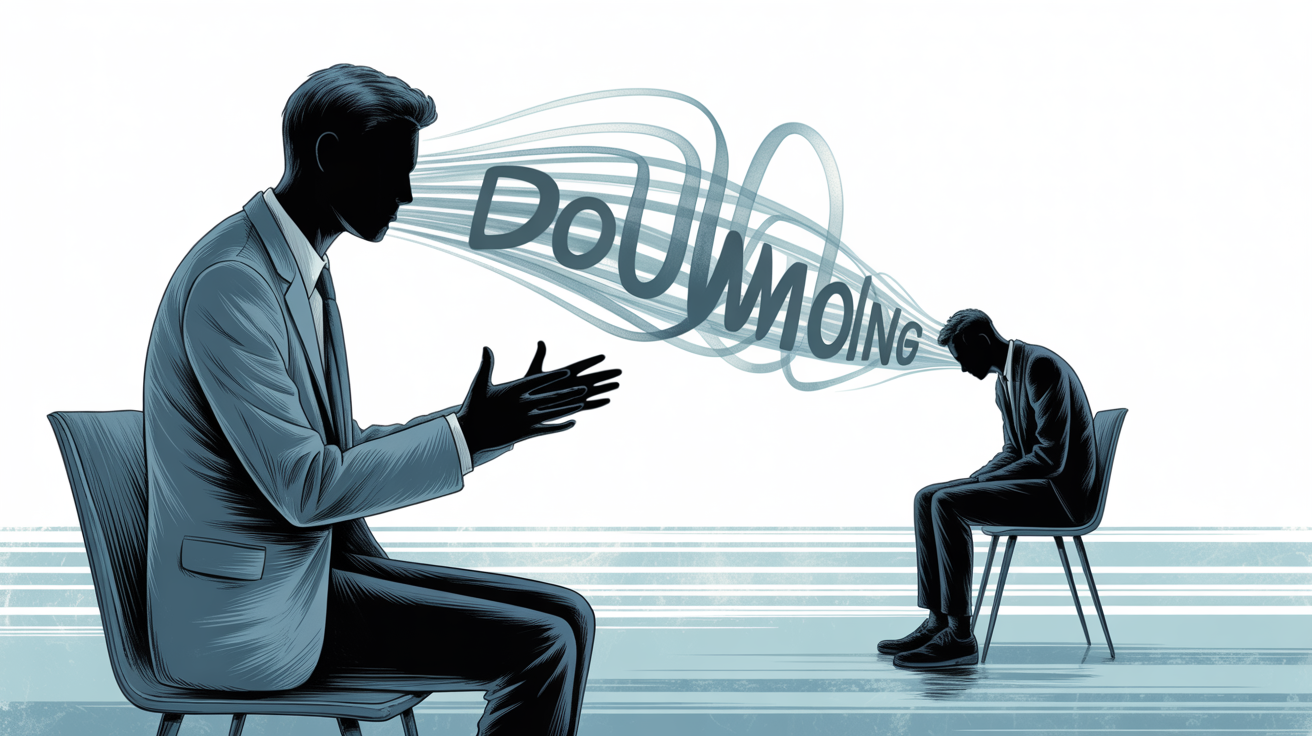
You put your heart into your work, your ideas, your conversations… and yet, you keep getting interrupted.
Overlooked.
Talked over.
Misunderstood.
Even when you say something insightful or important, it’s like no one hears it… until someone else repeats it.
And then they get the credit. They get the nod. They get the yes.
If you’ve ever walked away from a meeting, a sales conversation, or even a heart-to-heart talk,
“I wish I’d said that better…”
“Why didn’t they take me seriously?”
“I know I had the right idea, so why didn’t it land?”
You’re not alone.
You’re not doing anything “wrong.”
But… you might be missing something critical.
The truth is, it’s not always about what you say.
It’s about how you say it, and more importantly, how it lands in the subconscious minds of others.
That’s the part no one teaches us.
We’re taught grammar, logic, and delivery.
We’re told to be “clear,” “articulate,” “concise.”
But we’re rarely taught how to be heard.
How to speak in a way that makes people lean in, not tune out.
How to guide attention instead of chasing it.
How to communicate in a way that connects, not convinces.
The real problem?
Most people are trying to speak to logic…
While the decision-maker lives in the subconscious.
You may be pushing away connection without realizing it.
Let’s take a look at a few common habits that silently weaken your message:
Facts don’t move people. Feelings do.
If your message doesn’t spark emotion, the subconscious tunes it out.
Phrases like “I might be wrong but…” or “I just wanted to say…” tell the subconscious: “This isn’t important.”
Rushing, shrinking your voice, or ending sentences on a high pitch signals low confidence, even when your words are spot on.
The more we try to “prove” ourselves, the more we overwhelm or confuse.
Influence is about clarity, not complexity.
The subconscious mind prefers rhythm, metaphor, story, and emotional hooks.
If you speak to the conscious mind but ignore the subconscious… you’ll often be ignored, too.
Let’s clear this up:
You don’t have to be the loudest person in the room to be the most powerful.
You don’t have to dominate. You don’t have to perform.
And you don’t have to fake extroversion to be taken seriously.
True influence isn’t about being more, it’s about being intentional.
It’s about speaking to the parts of people that actually make decisions.
Their subconscious.
Their emotional core.
The part of them that feels, then responds.
We’ve all seen them.
That person who walks into a conversation and, without even trying, has the room’s attention.
They’re not necessarily the smartest. Or the most experienced.
But they communicate with a kind of calm confidence that makes people trust them, follow them, buy from them.
Here’s the truth:
That’s not magic. It’s not charisma.
It’s a learnable skill set.
They’ve learned, whether consciously or instinctively, how to speak in a way that aligns with how the brain responds.
This is what conversational hypnosis teaches you.
And no, it’s not about controlling others.
It’s about connecting at a deeper level than most people even realize is possible.
Let’s make this real:
You’re in a meeting and share a brilliant idea… silence. Someone else restates it later, and suddenly, it’s genius.
You pitch your service to a potential client… and they seem interested, but don’t say yes.
You try to explain your needs in a relationship… and feel like they just don’t “get it.”
You know you’re capable, but when you speak, it feels like your words evaporate.
If you’ve experienced this, your message isn’t weak.
It’s just not landing where it needs to.
Here are a few things you can try, right away, to start shifting your impact:
Lower your tone slightly when stating something important
Pause intentionally to create emphasis and presence
Replace “just” / “I think” / “sorry but…” with direct statements
Ask open-ended, emotionally evocative questions
Tell a short story or metaphor instead of dumping information
Small changes.
Big difference.
And when you combine those changes with deep-level tools that speak to the subconscious, you become impossible to ignore.
If no one ever taught you how to be influential, persuasive, and confident without “putting on a show”...
You’re not alone.
Most people were never taught.
But now you can learn.
Through Covert Conversational Hypnosis, you’ll learn how to:
Speak directly to the subconscious mind
Structure your message for trust and connection
Use language patterns that open minds, not trigger resistance
Influence ethically without pressure or pushiness
Communicate in a way that feels authentic, calm, and magnetic
And the best part? You can learn all of it from home.
The Covert Conversational Hypnosis Home Study Course was designed for people like you:
People who want to be heard but don’t want to perform
People who have something to say but want to say it powerfully
People who want to influence with integrity, not manipulation
You’ll learn at your own pace.
Practice in real-life conversations.
And discover how to shift how people respond to you, without becoming someone you’re not.
Whether you’re a coach, a leader, a parent, or simply someone who’s tired of feeling overlooked…
This course will give you the tools to be seen, heard, and trusted.
There’s nothing wrong with you.
You don’t need to yell.
You don’t need to hustle for attention.
You just need the right tools to deliver your message with confidence, clarity, and calm power.
Because your voice matters.
Your ideas matter.
And it’s time people started listening.
Explore the Covert Conversational Hypnosis Home Study Course and discover how subtle language patterns can shift how the world responds to you.
You’ve been overlooked long enough.
Let’s change that together.
Click here to learn more and enroll now.
You’ve Probably Heard the Phrase… “Just manifest it!”
It’s splashed across social media, whispered in late-night YouTube rabbit holes, and echoed in vision board workshops across the world.
And if you’re like many people, you may have tried it.
You focused on your goals.
You stayed positive.
You wrote down your desires.
You may have even visualized them every morning with your coffee.
But… nothing changed.
If that’s you, let’s get something clear right now:
You didn’t do it wrong.
You’re not broken.
And manifestation isn’t some fluffy fantasy that “just doesn’t work” for you.
The truth?
You’ve only been taught part of the story.
Pop culture has turned manifestation into a surface-level idea.
You’ve probably heard:
“Just think positive thoughts.”
“Visualize it and the universe will respond.”
“If you want it badly enough, it will appear.”
But what happens when it doesn’t?
Most people either blame themselves or give up on manifestation entirely.
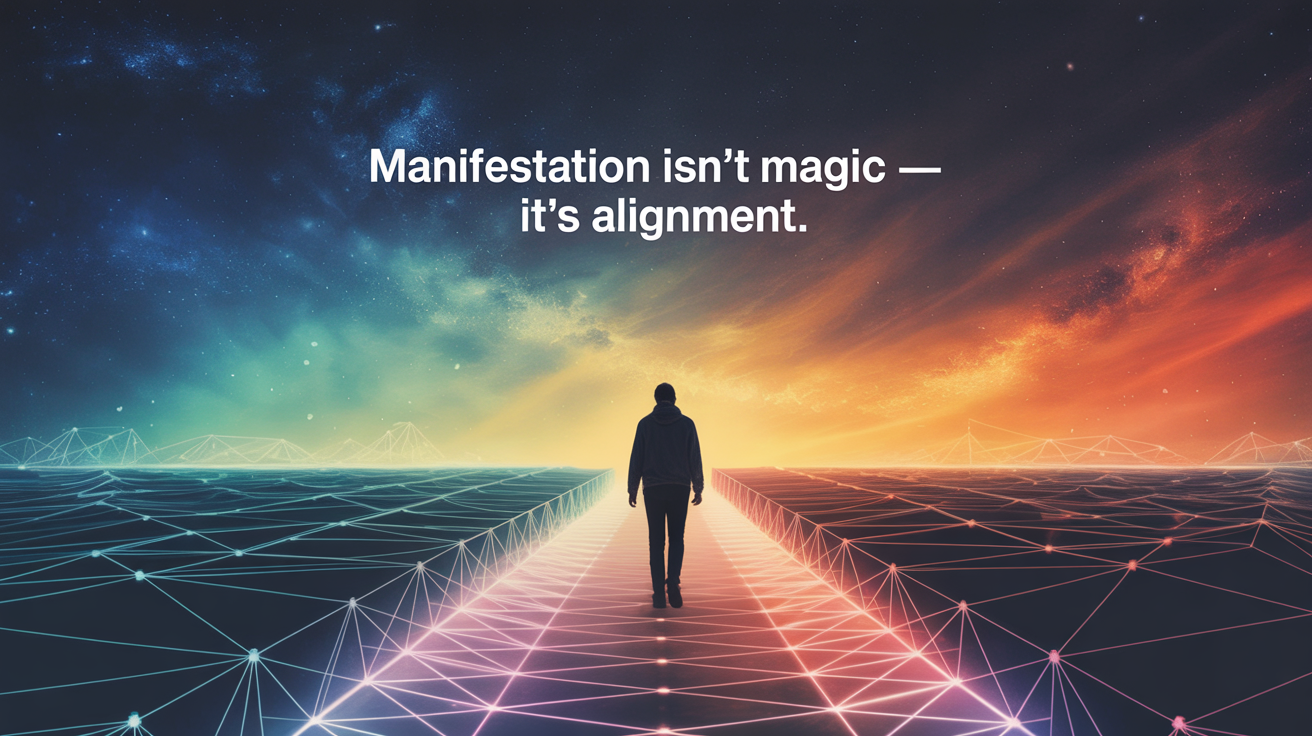
Here’s the truth: manifestation is not about magical thinking.
It’s about alignment.
It’s a system. A science. A process rooted in how your subconscious mind interacts with universal laws and energy.
When you understand how manifestation actually works, it stops being wishful thinking and starts becoming the tool for transformation it was meant to be.
Manifestation is the process of bringing a desired experience into your reality by aligning your:
Thoughts
Beliefs
Emotions
Identity
And actions
...with the outcome you want to create.
It’s not about forcing.
It’s not about begging the universe.
And it’s definitely not about bypassing reality with empty affirmations.
Manifestation is about energetic and behavioral congruence.
When what you want, believe, and expect are in alignment, you begin to naturally attract, notice, and act on the opportunities that match your frequency.
You might be saying,
“But I do think positively. I want change. I visualize my goals…”
Here’s the key: Your subconscious mind doesn’t respond to what you say. It responds to what you expect.
You might want more abundance, but unconsciously expect struggle.
You might desire love, but still carry beliefs that you’re unworthy.
You might set goals, but act from fear instead of faith.
This inner conflict is what blocks so many people from seeing results.
Because you can’t manifest a new reality while living from the energy of your old one.
Most people only know about the Law of Attraction. But did you know there are six universal laws that govern manifestation?
These laws work together like a framework. Ignore one, and things get stuck.
Here’s a brief look:
Law of Attraction – Like attracts like
Law of Vibration – Everything is energy (including your thoughts, emotions, and identity)
Law of Action – You must take aligned steps toward what you desire
Law of Polarity – Every desire contains its opposite (contrast helps you clarify)
Law of Cause and Effect – Every result is created by an input (including thoughts and beliefs)
Law of Compensation – The energy you give is returned, often multiplied
If manifestation feels like it’s “not working,” chances are… one of these laws is out of sync.
When you learn how to work with the full system, manifestation becomes practical and repeatable, not mystical and inconsistent.
This part is important.
Many people unknowingly work against their desires because of hidden beliefs like:
“If I succeed, I’ll lose people.”
“Money makes people selfish.”
“I don’t deserve more than I already have.”
“If I’m too happy, something bad will happen.”
These aren’t just thoughts.
They’re programs running your internal GPS. And no matter how hard you drive… you won’t reach your destination if your internal map is misaligned.
This is why NLP and subconscious reprogramming are so powerful.
They don’t just treat the surface symptoms, they change the settings behind the scenes.
Let’s ground this in something tangible.
Not just vague goals like “more money” or “better health.”
Define what you want in vivid, emotional detail.
Ask:
“Do I truly believe this is possible for me?”
If not, uncover the limiting beliefs holding you back.
You must feel the way you’d feel if it were already true.
Gratitude. Confidence. Peace. Safety.
It’s not about doing more, it’s about doing what’s congruent. Move as the version of you who already has the outcome.
Who are you being while you manifest? This is where real change happens at the level of self-image.
When your identity shifts, your thoughts shift.
When your thoughts shift, your actions shift.
When your actions shift, your results change.
This is why some people seem to “suddenly” have breakthroughs.
It’s not random.
They simply became someone who aligns with the life they desire.
And once you become that version of yourself, you can’t not attract it.
You don’t need to keep guessing.
You don’t need to piece it together from books, reels, or podcasts.
You can learn the entire manifestation system, step by step, with the Power to Manifest Now! Home Study Course.
Inside this self-paced training, you’ll discover:
The six universal laws that govern reality
How to identify and rewire limiting beliefs
Simple but powerful tools to shift your frequency and identity
NLP techniques that align your subconscious with your goals
And practical ways to manifest from clarity, not chaos
This isn’t fluff.
It’s a proven framework rooted in transformation, and thousands have used it to create real change in their lives.
If you’ve been frustrated, discouraged, or disconnected from the life you truly want, take this as a sign:
You don’t need to try harder.
You need to align better.
You’re not late.
You’re just waking up.
And the power to manifest now is already within you.
You just need the tools to activate it.
If you’re ready to understand how manifestation really works, and how to apply it in your own life, join us in the Power to Manifest Now! Home Study Course.
This is your next step toward clarity, confidence, and conscious creation.
You’ve waited long enough. Your transformation begins now.
Click here to get started.
Have you ever gotten so absorbed in a conversation, a movie, or even someone’s story that you completely lost track of time?
You weren’t distracted; you were deeply focused.
Your conscious mind faded into the background, and something deeper took over.
That wasn’t magic.
That was hypnosis.
And chances are, you’ve experienced it more often than you think.
It’s called conversational hypnosis, and once you understand how it works, you’ll begin to see it everywhere. Even more importantly, you’ll start to recognize just how powerful your words can become when used with intention and integrity.
At its core, conversational hypnosis is the art of influencing the subconscious mind through natural conversation.
It’s a form of communication that blends:
Subtle language patterns
Strategic tonality and pacing
Emotionally engaging storytelling
And psychological principles that bypass resistance
Unlike traditional hypnosis (the kind you might imagine with a swinging watch or eyes closed in a deep trance), conversational hypnosis happens while people are wide awake, and often without them realizing they’re being influenced at all.
It’s not coercion.
It’s not trickery.
It’s precision communication that’s designed to create connection, understanding, and transformation.
The roots of this approach can be traced back to Dr. Milton Erickson, a renowned psychiatrist and hypnotherapist who revolutionized the way we think about suggestion. He noticed that real change didn’t always happen in a formal trance… it often happened in stories, metaphors, and the spaces between words.

You did everything you were told.
You visualized the future you wanted.
You repeated affirmations.
You stayed positive, grateful, and hopeful.
And yet…
The money didn’t show up.
The opportunities felt just out of reach.
The breakthrough never quite landed.
If this sounds familiar, let’s be clear about one thing right away: There is nothing wrong with you.
What you’re experiencing isn’t failure. It’s feedback.
And it’s pointing to something most Law of Attraction advice completely overlooks.
The Silent Frustration No One Talks About
The Law of Attraction promises something deeply appealing: Change your thoughts, and you change your life.
And on the surface, that sounds true.
But here’s what many people quietly experience after months, or years, of trying:
You think positive… but still feel anxious underneath
You visualize abundance… but react with fear when money decisions arise
You “believe”… yet hesitate, procrastinate, or self-sabotage.
This creates a painful internal conflict.
You start wondering:
The answer isn’t effort.
The answer is alignment.

In today's fast-paced environment, achieving true transformation requires more than mere motivation.
It calls for a deep understanding of how our minds work. Neuro-Linguistic Programming (NLP) offers techniques to help you do just that.
By mastering mindset, you can unlock personal and professional success. This article explores how the Create Your Life: Live NLP Experience can guide you on this journey.
NLP is a method that combines neuroscience, linguistics, and psychology. It aims to improve communication and change behavior. Originating in the 1970s, Richard Bandler and John Grinder created NLP to understand how successful individuals achieve their results. They observed experts and formulated strategies that others could follow.
The core idea of NLP is that our thoughts, language, and behaviors are interconnected. By changing one, we can influence the others.
Techniques like reframing, anchoring, and modeling help individuals break free from limiting beliefs. These methods can alter how we perceive challenges and opportunities.
The potential impact of NLP on mindset is profound. It empowers people to take control of their lives by reshaping their internal dialogues. This leads to improved decision-making and enhanced personal growth.

Unlock the secrets to developing lasting positive habits and unshakeable confidence through our free NLP Home Study Course.
In a fast-paced world, personal growth is more crucial than ever. Neuro-Linguistic Programming (NLP) offers tools to master this growth.
It helps you understand and change your behavior in powerful ways.
Our free NLP Home Study Course guides you through this transformative journey.
NLP is about understanding how we think, communicate, and behave. It was developed to improve personal and professional life. By studying NLP, you can learn to create positive habits and boost your confidence. It’s a toolkit for change and growth.
NLP combines knowledge from psychology, linguistics, and communication. It helps you analyze patterns in your life. You can use these insights to make lasting changes. Whether you want to be more confident or adopt new habits, NLP has strategies to support you.
With NLP, you can transform your mindset. This transformation fosters growth and development. You begin to see opportunities and solutions instead of obstacles. NLP empowers you to take control of your life and achieve your goals.

In our fast-paced lives, career burnout is a common struggle. Many feel trapped in demanding jobs, leading to stress and exhaustion.
The good news is, personal transformation through Neuro-Linguistic Programming (NLP) and self-care can help. This article explores strategies for finding balance and overcoming burnout.
Career burnout is more than just feeling tired. It's a state of chronic stress that affects your health and happiness. Symptoms include fatigue, irritability, and a lack of motivation.
These can lead to poor performance and strained relationships. Recognizing these signs early is vital. Ignoring them can cause long-term damage to both your professional and personal life.
Several factors contribute to burnout. High workload, lack of control, and unclear expectations are common causes.
Emotional exhaustion often follows, leading to a sense of detachment. This cycle can be hard to break without intervention. Understanding these causes is the first step to preventing burnout.
Addressing burnout is crucial for maintaining a healthy work-life balance. It requires a proactive approach to manage stressors effectively.
Identifying the root causes can empower you to take control and make necessary adjustments in your life

Emotional Freedom Techniques (EFT) offer a unique path to emotional and physical liberation. As a coach, integrating EFT into your practice can empower your clients to overcome challenges and achieve personal transformation. This guide explores how EFT can enhance your coaching sessions by helping clients break free from negative emotions and physical discomfort.
EFT is a blend of ancient acupressure and modern psychology. This technique involves tapping on specific energy meridians to address emotional and physical issues. Originating from the principles of acupuncture, EFT is designed to release blockages within the body's energy system, promoting balance and well-being.
The tapping process is straightforward, making it accessible to both coaches and clients. By focusing on specific problems while tapping, individuals can experience relief from stress, anxiety, and pain. This technique is self-applied, allowing for flexibility and ease of use in various settings.
EFT has gained popularity due to its simplicity and effectiveness. It empowers individuals to take control of their emotional health, offering a practical tool for transformation.
This Blog
Subscribe
Bookmark This Page
Recent Posts
Recent Posts
Categories
